Overview
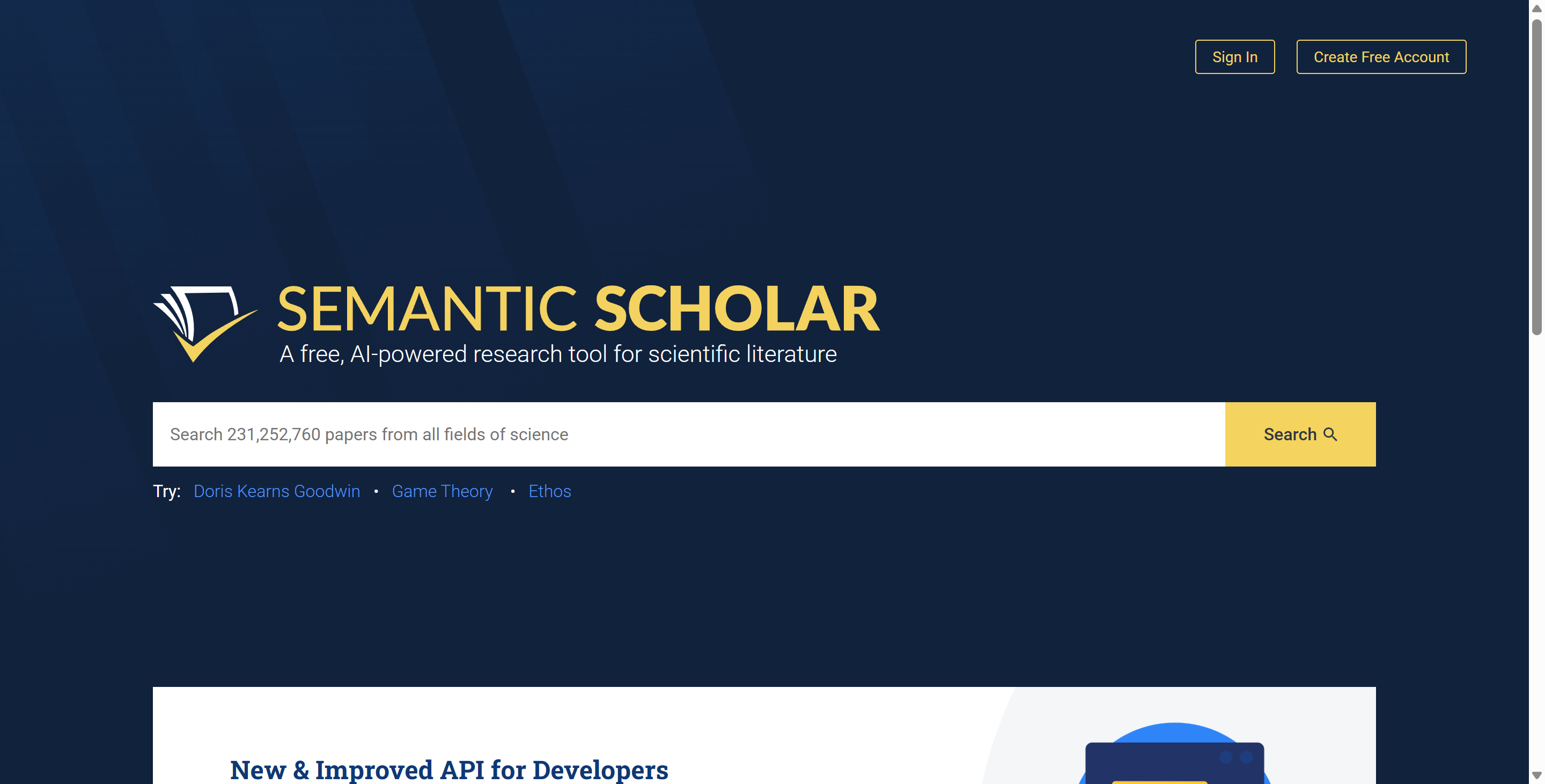
Semantic Scholar is the antidote to the "search-and-scroll" fatigue that plagues modern academic research. Developed by the non-profit Allen Institute for AI (AI2), Semantic Scholar is not just a database of papers; it is an intelligent research assistant that "reads" millions of scientific documents to understand their content, context, and intent. While traditional tools like Google Scholar rely heavily on keyword matching, Semantic Scholar leverages deep learning to grasp the semantics—the actual meaning—behind a query.
The core problem Semantic Scholar addresses is information overload. With the volume of scientific publishing doubling every few years, it is impossible for a human to read every relevant abstract. Semantic Scholar cuts through the noise by providing AI-generated summaries, highlighting influential citations, and offering personalized recommendations. Whether you are a PhD candidate conducting a literature review or a data scientist looking for the latest machine learning breakthroughs, Semantic Scholar provides a structured, intelligent layer over the world’s scientific knowledge. By identifying connections between papers that a simple keyword search might miss, Semantic Scholar accelerates scientific discovery and ensures you spend less time searching and more time reading what matters.
Key Features
-
TL;DR (Too Long; Didn't Read): One of the most beloved features of Semantic Scholar is its AI-generated "TL;DR." For millions of papers in computer science, biology, and medicine, Semantic Scholar provides a one-sentence summary of the paper's main objective and results. This allows researchers to skim through search results ten times faster, instantly grasping the core contribution of a paper without clicking through to the full abstract.
-
Semantic Reader (Beta): Semantic Scholar is redefining the reading experience with its "Semantic Reader." This augmented PDF viewer overlays intelligence onto the standard document. When you read a paper in Semantic Scholar, you can click on an in-text citation to see a summary of the referenced work without losing your place. It also highlights scientific terms and mathematical symbols, providing definitions and context on demand.
-
Highly Influential Citations: Not all citations are created equal. A paper might be cited 100 times, but 90 of those might be casual mentions. Semantic Scholar uses AI to classify citations, identifying which ones are "Highly Influential"—meaning the cited paper significantly impacted the methodology or results of the new work. This helps Semantic Scholar users trace the true lineage of an idea.
-
Research Feeds: Semantic Scholar acts as a personalized curator. Users can create folders in their library, and the Semantic Scholar AI analyzes the papers inside to generate a "Research Feed." This feed pushes new, highly relevant recommendations to you, ensuring you never miss a breaking paper in your specific niche.
-
Ask This Paper: Currently in beta for select papers, this feature turns Semantic Scholar into a conversational partner. Users can ask specific questions like "What dataset was used?" or "What are the limitations?" and Semantic Scholar will scan the full text to generate a precise answer, grounded in the document's content.
Use Cases
-
For PhD Students: Conducting a literature review is daunting. Semantic Scholar allows students to quickly build a "graph" of relevant research. By using the "Highly Influential Citations" filter, they can ignore noise and focus on the foundational papers that truly shaped their field.
-
For Data Scientists: As a product of an AI research institute, Semantic Scholar has the best coverage of computer science and AI papers. Developers use Semantic Scholar to find code implementations (often linked directly to GitHub) and keep up with the daily flood of ArXiv preprints using TL;DRs.
-
For Medical Researchers: Time is critical in medicine. Semantic Scholar helps clinicians and researchers quickly identify the results of clinical trials. The TL;DR feature is particularly tuned for biomedical literature, allowing professionals to assess the outcome of a study at a glance.
Pricing Plans
Semantic Scholar is distinct in the SaaS world because it is completely free.
There is no "Pro" version, no subscription fee, and no hidden paywall. As a non-profit initiative funded by the Allen Institute for AI, the mission of Semantic Scholar is to democratize science. Every feature—from the API used by developers to the advanced "Semantic Reader"—is available to every user at zero cost.
While Semantic Scholar is free, it does offer an API for developers. The Semantic Scholar API provides access to their massive academic graph. There is a free tier for low-volume use, and higher rate limits are available for partners and researchers, typically remaining free or low-cost to support open science. This commitment to open access makes Semantic Scholar a critical public utility in the academic ecosystem.
Pros & Cons
Pros
- Semantic Scholar is 100% free and ad-free, maintained by a non-profit organization.
- The "TL;DR" feature is a massive time-saver, summarizing complex papers into digestible one-liners.
- Semantic Scholar distinguishes between incidental and influential citations, offering a higher quality of bibliometrics than competitors.
- The interface is clean, modern, and significantly faster than legacy academic databases.
- Semantic Scholar provides direct links to code repositories (GitHub) and presentation slides when available.
Cons
- While growing, the database of Semantic Scholar (approx. 200M+ papers) is sometimes smaller than Google Scholar's comprehensive web crawl.
- The "TL;DR" and "Semantic Reader" features are heavily focused on Computer Science and Biomedicine, with less coverage for Humanities and Social Sciences.
- Semantic Scholar relies on open access; if a paper is behind a hard publisher paywall, the tool can often only show the abstract and metadata.
- Occasional AI errors can occur in the generated summaries, requiring users to double-check the abstract for critical details.