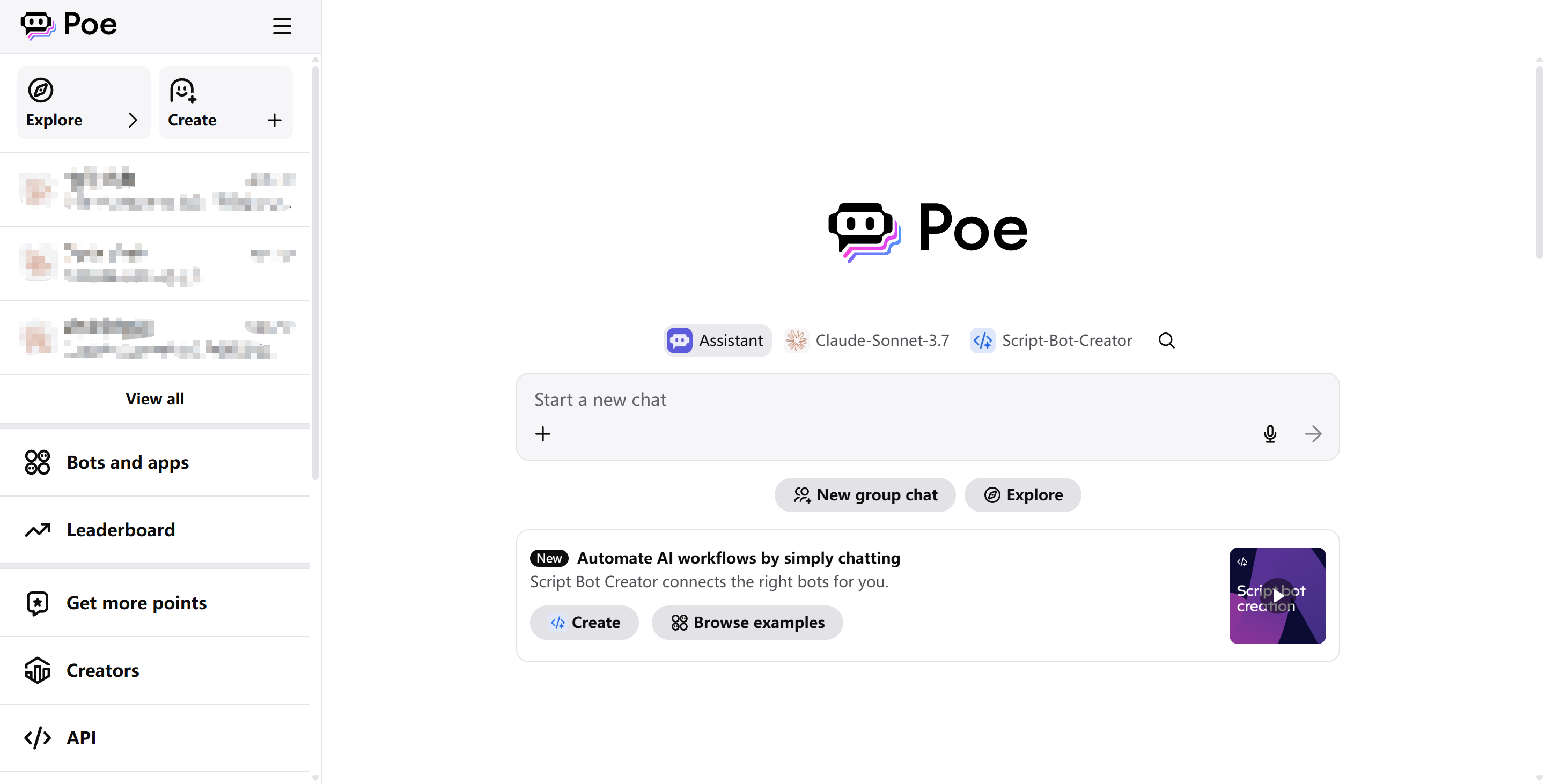
Overview
Poe (Platform for Open Exploration) has quickly established itself as the "web browser" of the artificial intelligence world. Launched by the knowledge-sharing giant Quora, Poe solves the fragmentation problem plaguing the AI industry. Currently, if you want the reasoning of OpenAI’s GPT-4o, the creative writing of Anthropic’s Claude 3.5 Sonnet, and the speed of Meta’s Llama 3, you would typically need three separate accounts and subscriptions. Poe consolidates all these powerful models into one streamlined interface. By serving as a neutral hub, Poe empowers users to choose the best "brain" for the task at hand without switching tabs or managing multiple billing cycles.
The brilliance of Poe lies in its community-driven ecosystem. Beyond just hosting official models from big tech companies, Poe allows anyone to create their own "bots." These custom Poe bots can be pre-prompted to act as coding tutors, travel guides, or role-playing characters. This has birthed a vibrant creator economy where thousands of unique AI personalities are available to explore. Whether you are a developer looking to compare model outputs or a casual user wanting a versatile assistant on your phone, Poe offers the most flexible and comprehensive AI experience on the market. With its seamless cross-platform synchronization, Poe ensures your conversations follow you from your desktop to your iPhone, making it a ubiquitous utility for modern digital life.
Key Features
-
Multi-Model Access: The flagship feature of Poe is its library of third-party Large Language Models (LLMs). Users can instantly switch between industry leaders like GPT-4o, Claude 3.5 Sonnet, Gemini Pro 1.5, and Mistral Large. This makes Poe an invaluable tool for "A/B testing" prompts; you can ask the same question to three different AIs within Poe to see which one provides the best answer.
-
Custom Bot Creation: Poe democratizes AI development. You do not need to know how to code to build a bot on Poe. Users can simply write a "system prompt" (instructions) and upload a "knowledge base" (PDFs or text files) to create a specialized chatbot. For example, a teacher could upload a syllabus and create a "History Tutor" bot on Poe that answers student questions based strictly on that document.
-
Creator Monetization: Poe has introduced a revenue-sharing model that rewards creators. If you build a popular bot that engages users or drives subscriptions, Poe pays you. This "Creator Economy" incentivizes high-quality prompts and unique bot personalities, ensuring that the Poe ecosystem is constantly flooded with new, innovative tools that go beyond standard chatbots.
-
Compute Points System: Unlike platforms that limit you to a set number of messages (e.g., "40 messages every 3 hours"), Poe utilizes a flexible "Compute Points" system. Every model on Poe is assigned a point cost based on its complexity. A simple query to a fast model might cost 20 points, while a complex request to GPT-4o might cost 300 points. This gives Poe users total freedom to budget their usage—spending their points on a few high-quality answers or thousands of quick chats.
Use Cases
-
For Prompt Engineers: Poe is the ultimate sandbox for testing. Professionals can run the same prompt across Poe's lineup of distinct models to analyze differences in tone, logic, and safety filters. This allows engineers to refine their prompts for specific underlying architectures without paying for multiple API keys.
-
For Mobile Power Users: The native Poe mobile app (iOS and Android) is widely considered faster and more stable than many competitors' apps. Users who need reliable AI access on the go use Poe to draft emails, summarize articles, or translate languages while commuting, benefitting from an interface designed specifically for mobile efficiency.
-
For Content Creators: Writers use Poe to overcome writer's block by leveraging different "personalities." They might use a "Creative Writer" bot on Poe for brainstorming plot twists, and then switch to a "Grammar Editor" bot to polish the final draft, keeping the entire workflow contained within the Poe dashboard.
Pricing Plans
Poe offers a simplified pricing structure that competes aggressively with buying direct subscriptions from model providers.
The Free Plan allows users to download the app and start chatting immediately. Free users get a daily allowance of "Compute Points" that resets every 24 hours. This is usually enough to use "faster" models (like Llama 3 8B or GPT-4o-mini) extensively, but access to premium models like GPT-4o or Claude 3.5 Sonnet is heavily restricted on the free tier of Poe, often limited to just one or two messages a day.
The Poe Subscription (priced at $19.99/month or $199.99/year) is where the real value lies. Subscribers receive a massive monthly allowance of Compute Points (typically 1,000,000 points per month). This creates a "near-unlimited" feel for most users. Furthermore, subscribing to Poe is often more economical than subscribing to ChatGPT Plus ($20) and Claude Pro ($20) separately. With Poe, you get access to the top-tier models from both companies for a single monthly fee. Subscribers also enjoy faster response times and priority access when Poe servers are under high load.
Pros & Cons
Pros
- Poe provides access to the widest variety of top-tier AI models under a single subscription.
- The "Compute Points" system offers more flexibility than strict message caps, allowing users to manage their own consumption.
- The mobile app for Poe is exceptionally polished, fast, and user-friendly.
- Poe allows users to monetize their prompt engineering skills through the creator program.
- Chat history on Poe syncs perfectly across all devices, allowing you to start a chat on the web and finish it on your phone.
Cons
- Poe acts as a middleman, so new features (like OpenAI's Voice Mode or Canvas) often arrive on Poe later than on the native platforms.
- Privacy-conscious users may worry that their data is being processed by both Poe (Quora) and the third-party model providers.
- The "Compute Points" can drain quickly if you exclusively use the most expensive, high-reasoning models on Poe.
- Poe currently lacks some of the advanced native ecosystem integrations, such as the ability to connect directly to custom GPT Actions or third-party APIs.