Overview
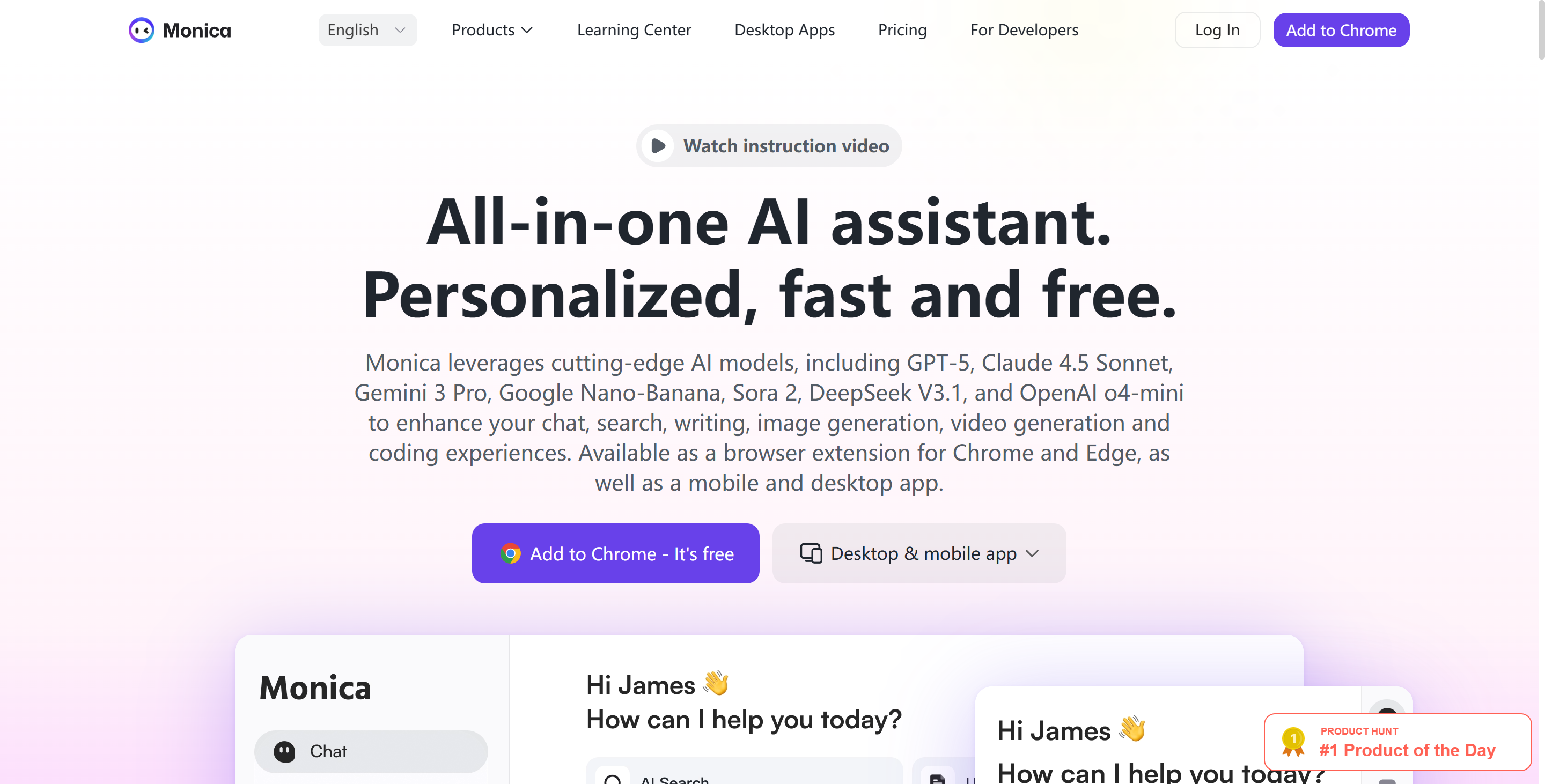
Monica is the ultimate solution to the "AI fragmentation" problem. In a world where we are constantly switching tabs between ChatGPT for reasoning, Claude for writing, and Google Translate for localization, Monica unifies these powerful tools into a single, sleek browser sidebar. Available as a Chrome extension, desktop app, and mobile application, Monica acts as your digital co-pilot, following you across the web to provide instant assistance exactly where you work.
The core technology behind Monica is an aggregator of the world's most advanced Large Language Models (LLMs). Instead of locking you into one ecosystem, Monica gives you the keys to all of them. Users can switch between OpenAI’s GPT-4o, Anthropic’s Claude 3.5 Sonnet, and Google’s Gemini 1.5 Pro with a single click. This flexibility ensures that whether you are coding, writing creative fiction, or analyzing financial data, you always have the best "brain" for the job. Beyond simple text generation, Monica connects these models to the live internet, allowing it to act as a search agent that reads, summarizes, and cites real-time information. By integrating directly into your browser workflow, Monica saves the average professional hours of copy-pasting and context-switching every week.
Key Features
- All-in-One Model Hub: The standout feature of Monica is its "Model Switcher." You are not forced to choose a single subscription; Monica provides access to the latest frontier models including GPT-4o, Claude 3.5 Sonnet, and Llama 3. This means you can ask Monica to write a poem using Claude, and then immediately ask it to debug Python code using GPT-4, all within the same chat interface.
- Web & YouTube Summarization: Monica excels at consuming content so you don't have to. When viewing a long article or PDF, you can click the Monica icon to instantly generate a concise summary, extraction of key points, or a mind map. Crucially, Monica also works on YouTube; it can watch a 20-minute tutorial in seconds and provide a timestamped breakdown of the video's content, allowing you to jump straight to the information you need.
- Monica Memo (Personal Knowledge Base): Monica includes a feature called "Memo," which functions as an external brain. You can save snippets of text, URLs, and screenshots into your Monica Memo. The AI then indexes this information, allowing you to "chat" with your own knowledge base later. For example, you can ask Monica, "What was that recipe I saved last week?" and it will retrieve the exact context from your saved items.
- Writing Agent (Compose): Monica integrates directly into text fields across the web, including Gmail, Twitter (X), and LinkedIn. The "Compose" module allows you to describe what you want to say (e.g., "polite decline to this email"), and Monica will generate a polished draft in your preferred tone. It can expand bullet points into full paragraphs or shorten verbose text into punchy social media posts.
Use Cases
- For Students & Researchers: Monica is a superpower for literature reviews. Students can open ten different academic tabs and use Monica to summarize each abstract instantly. The "Chat with PDF" feature allows them to upload dense papers and ask Monica specific questions like, "What is the methodology used?" without reading the entire document line-by-line.
- For Digital Marketers: Content creators use Monica to repurpose content efficiently. They can feed a blog post into Monica and ask it to "turn this into a Twitter thread" or "write a LinkedIn caption." The ability to switch to Claude 3.5 makes Monica particularly strong for generating human-sounding, creative copy that bypasses the robotic tone of standard AI.
- For Software Developers: Developers use Monica as a floating debugging companion. Because Monica lives in the sidebar, a coder can highlight an error message on Stack Overflow or GitHub and ask Monica to explain the bug and suggest a fix, all without leaving the documentation page they are reading.
Pricing Plans
Monica operates on a freemium model that is designed to be accessible while offering deep value for power users.
The Free Plan is generous but capped. It typically offers a daily limit of queries (e.g., 40 queries/day) using standard models. Free users of Monica can experience the sidebar, summarization, and translation features, but access to advanced "flagship" models like GPT-4o or Claude 3.5 is strictly limited or unavailable. This is perfect for casual users who just need a quick helper occasionally.
The Monica Pro plan (approx. $9.90/month) is the most popular tier. It unlocks access to the premium models (GPT-4, Claude 3.5, Gemini Pro) with a generous monthly quota (often around 3000-5000 queries for standard models and 200+ for advanced models). Pro users also get faster response times and access to "Clab," where Monica tests beta features.
For heavy users, the Monica Unlimited plan (approx. $19.90/month) removes the shackles. It provides unlimited queries for standard models and a significantly higher cap (or unlimited depending on fair use) for advanced models. Monica Unlimited subscribers also gain priority access to image generation features (using DALL-E 3) and extended context windows for analyzing massive PDF files.
Pros & Cons
Pros
- Monica eliminates the need for multiple subscriptions by bundling GPT-4, Claude, and Gemini into one price.
- The sidebar interface is non-intrusive and integrates seamlessly into the browsing workflow.
- Monica offers excellent "Read Aloud" and "Voice Chat" features, making it accessible for users who prefer audio.
- The "Memo" feature gives Monica long-term memory, which most standard chatbots lack.
- Monica is available on virtually every platform: Chrome, Edge, Windows, Mac, iOS, and Android.
Cons
- The daily query limits on the free version of Monica can be frustratingly low for serious work.
- Some advanced features, like high-resolution image generation, cost extra "credits" even on paid plans.
- Because Monica injects itself into webpages, it can sometimes conflict with other browser extensions or clutter the UI (though it can be disabled for specific sites).
- Monica relies on third-party APIs (OpenAI, Anthropic), so if those services go down, Monica goes down too.